
Measles is a highly contagious disease which is spread by coughs and sneezes.
Common symptoms include:
-
high fever
-
sore, red and watery eyes
-
coughing
-
sneezing
Small white spots may appear inside the mouth.
A blotchy red or brown rash usually appears after a few days, typically on the face and behind the ears, before spreading.
The rash can be harder to see on brown and black skin.
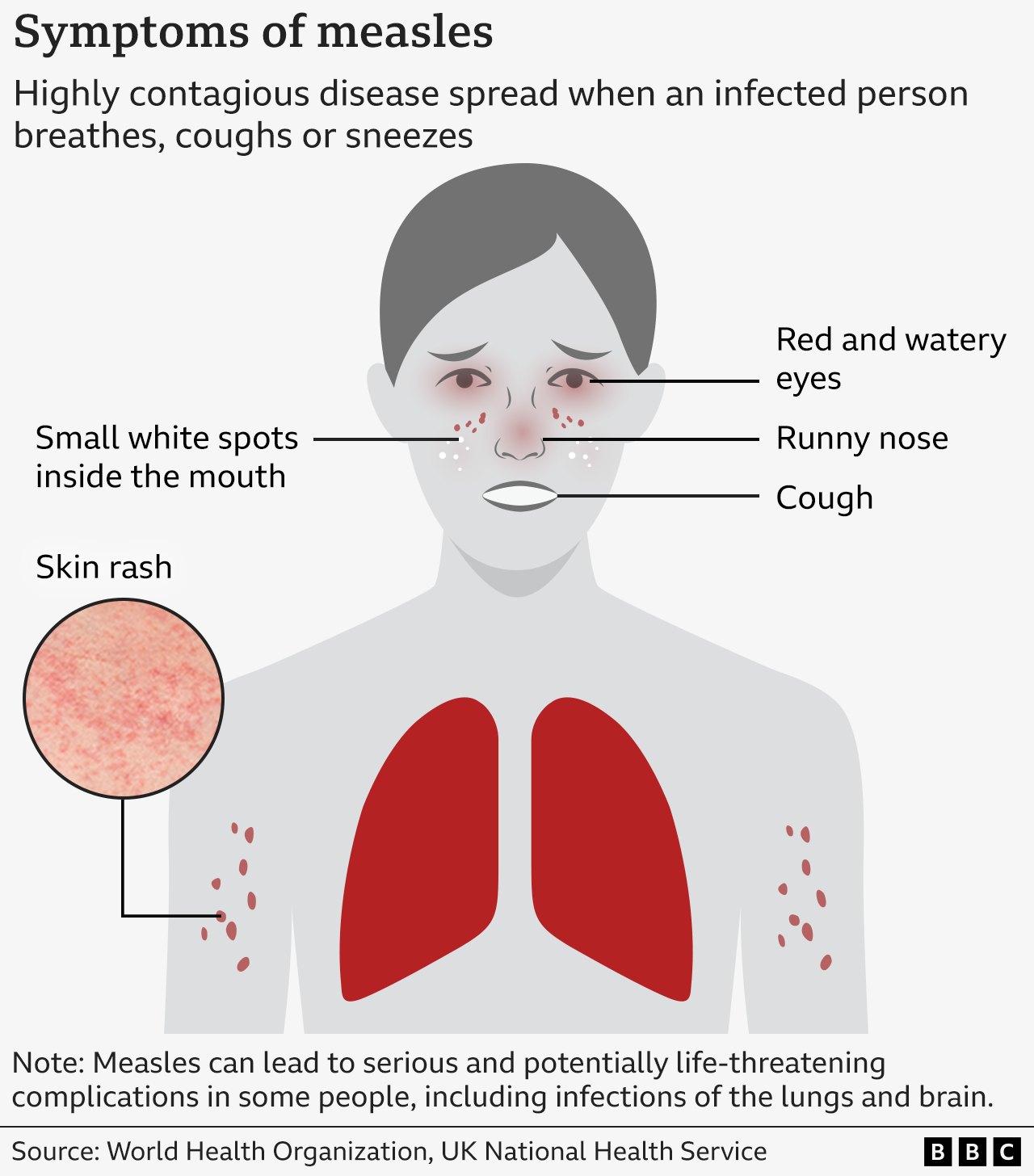
Measles normally clears up within seven to 10 days. However, it can lead to pneumonia, meningitis, blindness and seizures.
Ask for an urgent GP appointment or get help from NHS 111 if:
- you think you or your child may have measles
- your child is under 1 year old and has come into contact with someone who has measles
- you’ve been in close contact with someone who has measles and you’re pregnant or have a weakened immune system
- you or your child have a high temperature that has not come down after taking paracetamol or ibuprofen
- you or your child have difficulty breathing – you may feel more short of breath than usual
- your baby or young child is not feeding well, or taking less feeds or fluids than usual
- you or your child are peeing less than usual (or your baby has fewer wet nappies)
- you or your child feels very unwell, or you’re worried something is seriously wrong
Measles can spread to others easily. Call your GP surgery before you go in. They may suggest talking over the phone.
You can also call 111 or get help from 111 online.
How to look after yourself or your child
Measles usually starts to get better in about a week.
After seeing a GP, there are things you can do to help ease the symptoms and reduce the risk of spreading the infection.
It can help to:
- rest and drink plenty fluids, such as water, to avoid dehydration
- take paracetamol or ibuprofen for a high temperature
- give your child paracetamol or ibuprofen if they’re distressed or uncomfortable – check the packaging or leaflet to make sure the medicine is suitable for your child, or speak to a pharmacist or GP if you’re not sure
- use cotton wool soaked in warm water to gently remove any crusts from your or your child’s eyes
Important
Stay off nursery, school or work for at least 4 days from when the rash first appears.
Also try to avoid close contact with babies and anyone who is pregnant or has a weakened immune system.
How to avoid spreading or catching measles
Measles is spread when an infected person breathes, coughs or sneezes.
You’re infectious from when you first have symptoms (around 4 days before the rash appears) until 4 days after you get the rash.
There are things you can do to reduce the risk of spreading or catching measles.
Do
-
wash your hands often with soap and warm water
-
use tissues when you cough or sneeze
-
throw used tissues in the bin
Don’t
-
do not share cutlery, cups, towels, clothes, or bedding
Complications of measles
Measles can lead to serious problems if it spreads to other parts of the body, such as the lungs or brain.
Problems that can be caused by measles include:
- pneumonia
- meningitis
- blindness
- seizures (fits)
These problems are rare, but some people are more at risk. This includes babies and people with weakened immune systems.
Measles in pregnancy
If you get measles when you’re pregnant, it could harm your baby.
It can cause:
- miscarriage or stillbirth
- premature birth (before the 37th week of pregnancy)
- your baby having a low birthweight
It’s important to get medical advice if you’re pregnant and have been in close contact with someone who has measles.
Immediate action required: Call 999 or go to A&E if:
You or your child has measles and:
- have a seizure (fit)
- severe difficulty breathing – you’re gasping, choking or not able to get words out (babies may make grunting noises or their stomach may suck under their ribcage)
- are unable to stay awake – cannot keep their eyes open for more than a few seconds
- suddenly become confused – your child may be very unsettled, behaving differently, or crying non-stop
- your child is limp, floppy or not responding normally – their head may fall to the side, backwards or forwards, or they may find it difficult to lift their head and focus on your face
- a rash that does not fade when you press a glass against it
- a stiff neck, or find light uncomfortable or painful
Do not drive to A&E. Ask someone to drive you or call 999 and ask for an ambulance.
Bring any medicines you take with you.
Get vaccinated against measles
The MMR vaccine can prevent measles. It also protects you from mumps and rubella.
The MMR vaccine is offered to all children in the UK. 2 doses can give lifelong protection against measles, mumps, and rubella.
Ask at your GP surgery if you’re not sure you or your child have had the vaccine. They can give it for free on the NHS.
